

Colorado has no presumption of an equal split. A judge starts from the child’s best interests, and an equal schedule has to fit that.
Colorado is not a 50/50 state by default. No statute directs a judge to begin from an equal split, and there is no presumption in favor of one. Equal parenting time is a workable outcome where it fits the family, and it is decided the same way every other schedule is.
Colorado orders allocate parental responsibilities rather than awarding custody. That covers two separate things: parenting time, meaning the physical schedule, and decision-making responsibility, meaning who decides the major questions.
That separation matters, because the two are decided separately and do not have to match.
What the Court Actually Weighs
The decision runs on the best interests standard, and the statute sets out the factors a court considers.1 No single factor decides a case, and a court weighs them together rather than scoring them.
Several factors look at the child rather than the parents. The child’s adjustment to home, school, and community is one. So is the physical proximity of the parties to each other, which is the factor that does the most quiet work in an equal-time case.
Proximity matters because an equal schedule has to survive a Tuesday. Where a midweek exchange means a long drive on a school night, the schedule starts costing the child something. That is a practical point rather than a prediction about how a judge will rule.
Other factors look at the parents. The court considers each party’s ability to place the child’s needs ahead of their own. It also weighs the ability to encourage the sharing of love, affection, and contact between the child and the other party.
That second factor has a limit worth knowing. Where the court determines a party acted to protect the child from abuse or domestic violence, those protective actions are not counted against them. The protection covers a child witnessing domestic violence as well as being a victim.
Where abuse is alleged, a 2026 act changes what the court must do. It requires findings on the record, by a preponderance of the evidence, on three questions.2 Those are whether a party committed domestic violence, child abuse or neglect, or sexual assault that resulted in the conception of the child.
If the court makes any of those findings, two things follow. It must impose conditions on parenting time that ensure the safety of the child and the abused party. It must also consider whether to prohibit or restrict that party’s parenting time altogether.
Mutual decision-making is also off the table over the other party’s objection, unless the court makes specific findings that it can occur without coercion, intimidation, retaliation, or risk of harm. An equal schedule is not the starting point in that situation.
One more provision is worth knowing. If a party left home because of that abuse, the absence is not a factor in determining the child’s best interests.
A history of involvement is evidence a court will hear, and it is worth documenting. It is not a presumption, and there is none based on a parent’s sex either.
Does My Child Get to Choose?
A child’s wishes are one factor, weighted by age and maturity, and they are never the whole answer. A thoughtful sixteen-year-old’s reasons about staying in a school district carry more weight than a younger child’s preference, but neither decides the case.
Children are usually kept out of the courtroom, though the picture is more nuanced than that. On a motion, a court may interview the child in chambers to learn their wishes, and it must make findings explaining why it granted or denied that request.3 The interview is recorded and becomes part of the case record.
One situation carries extra weight. Where a child has alleged domestic violence, child abuse or neglect, or child sexual abuse, the court gives paramount consideration to that allegation. That consideration applies in deciding whether to interview the child in chambers.
More often the court appoints a child and family investigator, a neutral third person who investigates and reports on the best interests factors as the appointment order directs.4 A CFI may be an attorney, a mental health professional, or another person with appropriate training.
There is a qualification gate worth knowing about. A neutral professional the court appoints to opine on abuse or trauma must hold demonstrated expertise and experience working with victims that is not solely forensic.5 A CFI without those qualifications can investigate and report, but not opine on those questions.
Hoping for an equal schedule?
What decides these cases is whether the schedule works in practice, not whether it is even on paper. Schedule a free consultation with Johnson Law Group and we will look at your week and tell you what a court is likely to focus on.
What 50/50 Schedules Actually Look Like
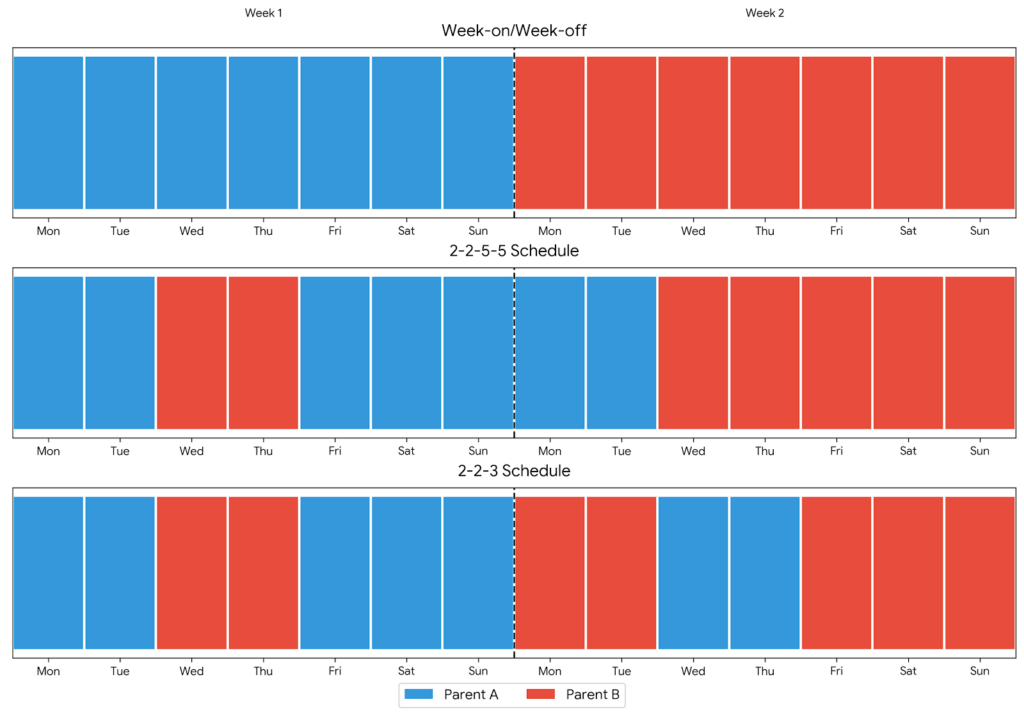
Colorado does not mandate a particular schedule, so equal time is a goal rather than a fixed calendar. Three structures come up most often, and they differ mainly in how long the child goes between homes.
Week on, week off
The child spends seven days with each parent before switching. This minimizes exchanges, which suits families where handovers are a friction point, at the cost of longer gaps from each parent.
The 2-2-5-5 rotation
One parent has Monday and Tuesday every week, the other has Wednesday and Thursday, and the parents alternate the Friday to Sunday block. Each parent ends up with the same two weekdays every week, which is why families pick it for routine, and each gets a five-day stretch every other week.
The 2-2-3 rotation
Parents alternate in short blocks of two, two, and three days, reversing the following week so the pattern balances over a fortnight. The appeal is short gaps, which is a common reason families choose it for younger children, though the trade-off is frequent exchanges.
Which one holds up depends on the drive, the school week, and how well the two of you handle handovers. Picking a rotation is one piece of building a Colorado child custody arrangement, and the schedule you choose shapes the rest of the plan. If an equal split does not fit, Colorado parenting time schedule options walks through the other schedule structures a plan can use.
Decision-Making Is a Separate Question
Even with an equal schedule, who decides the major questions is a distinct ruling. The Judicial Branch parenting plan form allocates education, non-emergency medical care, and religious upbringing as separate categories.6 Daily matters like bedtime or meals sit with whichever parent has the child.
A court can order the parents to decide jointly, or give one parent sole authority in one area or all of them. Hybrid arrangements are possible too, including plans that make one parent the tie-breaker on education and the other on medical questions.
The clauses that make this work are specific: exchange times and locations, holiday and vacation division, transportation, and how a deadlock gets broken. A Colorado parenting plan that leaves any of those vague is where next year’s argument starts.
Building the Case for Equal Time
Keep a simple private log of your involvement. Homework, parent-teacher conferences, medical appointments, and the ordinary logistics of the week all show a pattern, and a contemporaneous record beats recollection.
Bring a proposed parenting plan rather than a position. A specific schedule, holiday and vacation terms, and clear transportation arrangements show you have thought past the argument to how the week would actually run.
Keep your written communication child-focused and calm. Texts and emails end up in front of a court more often than parents expect, and a steady tone under provocation is evidence in its own right.
Mediation, and When You Do Not Have to Do It
Colorado courts commonly send parenting disputes to mediation, and many districts do so as a matter of routine. The referral is discretionary rather than automatic, and a court may exempt a case where a party files within five days showing compelling reasons.7 Mediation is confidential, and the mediator facilitates rather than decides.
There is an important exception the shorter guides tend to skip. A court shall not refer a case to mediation where a party claims to have been the victim of physical or psychological abuse by the other party.
The statute adds that the exception applies at any time and regardless of prior participation, provided the party states they are unwilling to mediate. Prior mediation in the case does not spend the protection.
The Colorado Supreme Court has treated the exception as a firm bar. It held that a party does not need to raise it before a mediation order is entered.8
If you are in that position, you do not have to sit across a table from someone who harmed you in order to move your case forward. Raise it as soon as you can, because the protection has to be invoked, but it is not lost because an order has already issued. How the process works otherwise is covered in how divorce mediation works in Colorado.
Where mediation does fit, an agreement you build yourselves can be entered as an order, and it usually holds up better than one imposed after a hearing.
Frequently Asked Questions
Is Colorado a 50/50 custody state?
No. There is no presumption of an equal split and no statute directing a judge to start from one. Equal parenting time is a workable arrangement where it fits the family, decided under the same best interests standard as any other schedule.
What matters most in getting equal parenting time?
Whether the schedule works in practice. The physical proximity of the two homes carries weight, as does the child’s adjustment to school and community. So does each parent’s ability to put the child first and support the other relationship.
Can my child tell the judge where they want to live?
A child’s wishes are one factor, weighted by age and maturity. On a motion the court may interview the child in chambers and must explain why it granted or denied that request. Where a child has alleged abuse or domestic violence, that allegation gets paramount consideration in the decision to interview.
Do I have to go to mediation?
Usually courts refer parenting disputes to mediation, but referral is discretionary. A court may not refer a case where a party claims physical or psychological abuse by the other party and states they are unwilling to mediate. Raise it early if that applies to you.
Does a 50/50 schedule mean we share all the decisions?
Not automatically. Parenting time and decision-making responsibility are allocated separately. You can have an equal schedule while one parent holds sole decision-making in a particular area, or while the plan names a tie-breaker for specific subjects.
Talk With a Colorado Family Law Attorney
The question that decides these cases is not what is fair between the two of you. It is whether the schedule you are proposing supports your child’s week, and whether you can show it.
Johnson Law Group handles parenting time and decision-making matters across the state, and you can learn more about our approach on our Colorado family law page. You can find our offices in Denver, Colorado Springs, Commerce City, Englewood, and Fort Collins. You can also read about the background and experience of the attorneys on our team.
Schedule a free consultation and we will help you build a plan a court can adopt.
Sources
[2] HB26-1309 (2026), Abuse in Cases of Separation, 2026 Colo. Sess. Laws ch. 163, sections 2 and 3 as enacted | https://leg.colorado.gov/laws/session-laws/HB26-1309/163/download
[3] C.R.S. § 14-10-126 – interviews; in-chambers interview on motion, required findings, and paramount consideration where a child alleges abuse (as amended by HB24-1350, 2024) | https://colorado.public.law/statutes/crs_14-10-126
[4] C.R.S. § 14-10-116.5 – appointment of a child and family investigator | https://colorado.public.law/statutes/crs_14-10-116.5
[5] C.R.S. § 14-10-127.5 – qualifications required before an appointed professional may opine on abuse or trauma | https://colorado.public.law/statutes/crs_14-10-127.5
[6] JDF 1113, Parenting Plan – Colorado Judicial Branch, for the decision-making categories a plan allocates | https://www.coloradojudicial.gov/self-help/family
[7] C.R.S. § 13-22-311 – court referral to mediation, and the bar on referral where a party claims abuse | https://colorado.public.law/statutes/crs_13-22-311
[8] Pearson v. District Court, 924 P.2d 512 (Colo. 1996) – the abuse exception to court-ordered mediation | https://law.justia.com/cases/colorado/supreme-court/1996/96sa64-0.html