
Divorce is one of the most significant legal decisions you’ll ever make — and in Colorado, the process has specific rules that affect your timeline, your rights, and your financial future. Whether you’re just starting to research your options or you’re ready to file, this guide walks you through every step.
Here’s what you need to know about how to file for divorce in Colorado in 2026.
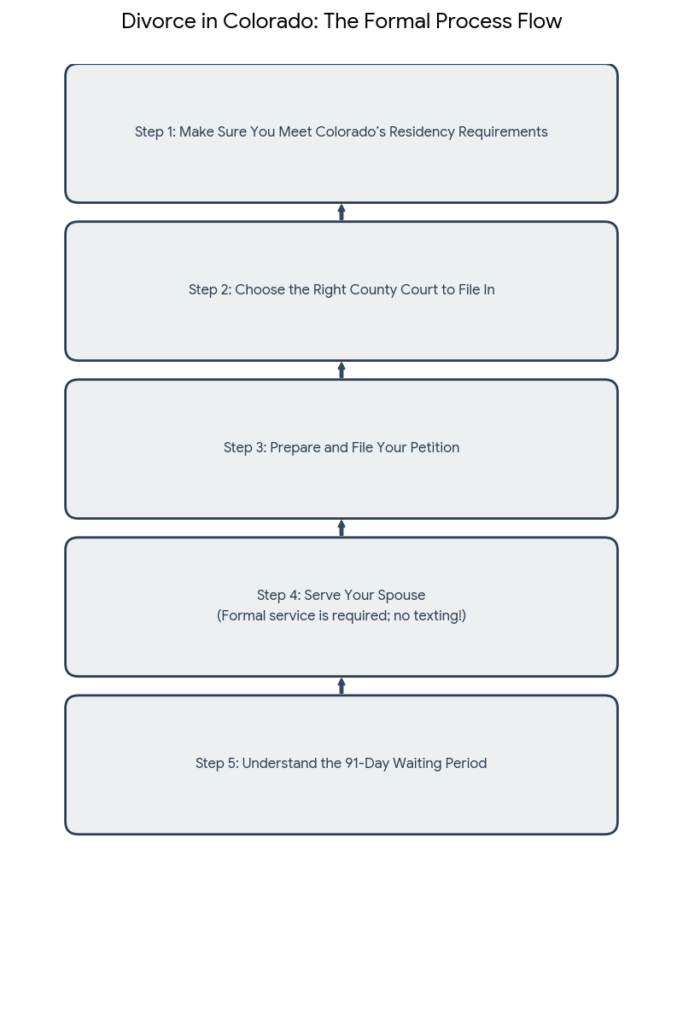
Step 1: Make Sure You Meet Colorado’s Residency Requirements
Before you can file for divorce in Colorado, you or your spouse must have lived in the state for at least 91 days prior to filing. That’s it — there’s no minimum marriage length required, and you don’t need to prove fault.
Colorado is a no-fault divorce state, which means you simply declare that the marriage is “irretrievably broken.” You don’t need to prove infidelity, abuse, or any other wrongdoing to move forward.
If you or your spouse is in the military, special rules may apply — contact an attorney to confirm your eligibility.
Step 2: Choose the Right County Court to File In
You’ll file your divorce petition with the District Court in the county where you or your spouse lives. Some of the most common filing locations in Colorado include:
- Denver County District Court (Denver)
- Jefferson County District Court (Lakewood, Arvada, Wheat Ridge)
- Arapahoe County District Court (Centennial, Englewood, Aurora)
- El Paso County District Court (Colorado Springs)
Each court has its own local procedures, filing portals, and scheduling systems — so it’s worth knowing what to expect in your specific jurisdiction.
Step 3: Prepare and File Your Petition
To start the process, you’ll file a Petition for Dissolution of Marriage (JDF 1101) with the appropriate court. This document officially begins your divorce case.
Along with the petition, you’ll typically file:
- Summons (JDF 1102) — served on your spouse
- Case Information Sheet (JDF 1000)
- Sworn Financial Statement (JDF 1111) — required in cases involving finances or property
- Parenting Plan (JDF 1113) — required if you have minor children
Colorado’s courts have standardized forms available online through the Colorado Judicial Branch website (courts.state.co.us). However, filling out these forms incorrectly is one of the most common mistakes people make — and errors can delay your case by weeks.
Filing fee: As of 2026, the filing fee is approximately $230 in most Colorado counties. Fee waivers are available if you qualify based on income.
Step 4: Serve Your Spouse.
After filing, your spouse must be formally served with the divorce papers. Colorado law requires proper service — you can’t just text them a copy.
Options for service include:
- Personal service — a sheriff’s deputy or process server delivers the papers directly
- Acceptance of service — your spouse signs a form acknowledging receipt (common in uncontested cases)
- Certified mail — allowed in some circumstances
- Publication — a last resort if your spouse cannot be located
Once your spouse is served, they have 21 days (if served in Colorado) or 35 days (if served out of state) to file a response.
Step 5: Understand the 91-Day Waiting Period
Colorado law requires a minimum 91-day waiting period after your spouse is served before a divorce can be finalized. This is sometimes called the “cooling off” period — it’s mandatory, even if both parties agree on everything from day one.
This doesn’t mean your divorce takes 91 days. In a simple uncontested case, the 91-day clock runs while you’re completing paperwork, negotiating agreements, and preparing for a final hearing. In contested divorces, the process often takes 12 to 18 months — sometimes longer.
In summary this is what the process looks like.
Contested vs. Uncontested Divorce: What’s the Difference?
Understanding whether your divorce is contested or uncontested is one of the most important distinctions you can make early on.
Uncontested Divorce
An uncontested divorce means both spouses agree on all major issues:
- Division of property and debts
- Spousal maintenance (alimony)
- Child custody and parenting time
- Child support
When both parties are aligned, the process is faster, cheaper, and far less stressful. You may be able to finalize your divorce without a court hearing using Colorado’s Simplified Divorce Procedure — but only if you meet strict eligibility requirements (short marriage, no children, minimal shared assets).
Contested Divorce
A contested divorce means you and your spouse disagree on one or more major issues. These cases require:
- Discovery (financial disclosures, document requests)
- Negotiations between attorneys
- Possibly mediation
- A final hearing or trial before a judge
Contested divorces are significantly more expensive and emotionally taxing. If children are involved, the stakes are even higher — custody and parenting time disputes can become the most contentious part of any divorce case.
When Do You Need an Attorney?
This is a question we hear constantly — and the honest answer is: it depends on your situation.
Mediation May Be Enough If:
- Your marriage was short with minimal shared assets
- You and your spouse communicate reasonably well
- There are no children involved
- You broadly agree on how to divide things
Mediation is a process where a neutral third party helps you reach agreement on divorce terms. It’s faster and cheaper than litigation, and in Colorado, courts often require it before a contested hearing.
You Need an Attorney If:
- You have children and disagree about custody or parenting time
- There’s significant property, retirement accounts, or a business to divide
- One spouse has a significantly higher income
- There’s a history of domestic violence, substance abuse, or hidden assets
- Your spouse has already hired an attorney
Here’s the truth: if your spouse has a lawyer and you don’t, you are at a significant disadvantage. An experienced Colorado family law attorney protects your rights, ensures disclosures are accurate, and fights for outcomes that serve you long-term — not just in this moment.
Step 6: Reach an Agreement or Go to Trial
Once both parties have exchanged financial disclosures, the negotiation phase begins. Most cases — even contested ones — settle before trial. Settlement can happen through:
- Direct negotiation between attorneys
- Mediation (required in most Colorado counties before a final hearing)
- Collaborative divorce — a structured process where both parties commit to resolving issues out of court
If no agreement is reached, your case proceeds to a final orders hearing (trial), where a judge decides unresolved issues. Judges in Denver, Jefferson County, Arapahoe County, and El Paso County all follow Colorado Revised Statutes — but local practices and judge preferences can vary.
Step 7: Final Decree of Dissolution
Once all issues are resolved and the 91-day waiting period has passed, the court issues a Decree of Dissolution of Marriage. This is the legal document that officially ends your marriage.
Make sure you receive certified copies — you’ll need them to update financial accounts, change your name, and handle other post-divorce tasks.
Frequently Asked Questions
Q: How long does a divorce take in Colorado?
A: At minimum, 91 days (the mandatory waiting period). Simple uncontested divorces often wrap up in 3–6 months. Contested divorces can take 12–24 months or more, depending on the complexity of the issues involved.
Q: Can I file for divorce without a lawyer in Colorado?
A: Yes. Colorado courts have standardized forms and self-help resources. However, going it alone is risky if children, significant assets, or disagreements are involved. Mistakes in your paperwork or agreements can have long-lasting consequences.
Q: Does it matter who files first in Colorado?
A: Not significantly. Colorado is a no-fault state, so filing first gives you a slight procedural advantage but doesn’t change outcomes on custody or property division.
Q: What is “equitable distribution” in Colorado?
A: Colorado divides marital property equitably — which means fairly, but not necessarily 50/50. Courts consider factors like each spouse’s financial circumstances, contributions to the marriage, and the economic effect of the division.
Q: What happens if my spouse refuses to respond to the divorce petition?
A: If your spouse is properly served and doesn’t respond within the required timeframe, you can request a default judgment — allowing the court to grant the divorce based on your petition alone.
Contact Johnson Law Group For Your Custody Matter
Navigating Colorado’s evolving divorce rules requires more than just a guide—it requires an advocate. At Johnson Law Group, we turn legal requirements into protected futures for you and your children. Ready to move from research to action? Schedule a confidential consultation at 720-445-4444 or visit divorce consultation pageto secure your parental rights today.