
Colorado Legal Separation Laws
What Actually Changes With a Legal Separation
A legal separation resolves the same issues a divorce does, parenting, support, and the division of property and debt, through the same court process. The difference is narrower than most people expect: a legal separation does not end your marriage.[1]
Neither spouse can remarry while a separation decree is in place, and the marriage stays legally intact until a court grants a motion to convert the separation into a divorce decree.
Whether that distinction matters to you depends on why you are considering separation in the first place, and that reason should drive the decision, not the other way around.
Colorado Family Law Practice Areas:

2023 Selection

2023 Selection

2022 Selection

2021 Selection

2020 Selection

2019 Selection

2018 Selection

2024 Selection
Why Some People Choose Separation Instead of Divorce
People pick legal separation over divorce for a handful of recurring reasons. Religious objections to divorce are one. Others want to keep eligibility for a spouse’s health coverage or another marriage-linked benefit, need time before deciding, or are weighing tax and immigration questions.
Treat each of those benefits as a question to check rather than an assumption. Whether a plan keeps covering a legally separated spouse depends on the plan’s own terms. Confirm it with the plan administrator in writing before you rely on it.
Federal law does not decide that question, but it can give you a safety net if the plan does end your coverage. Under COBRA, legal separation counts as a qualifying event, the same as divorce, when it would cause you to lose coverage under the plan. If that happens, you may be able to continue the coverage yourself.
COBRA does not reach every employer plan, and some public and military plans work differently. Ask the administrator which rules govern your specific plan. Get that answer before the decree enters, not after.
If the separation does end your coverage, federal law puts the notice job on you or the covered employee, generally within 60 days. A late notice can cost you the chance to continue coverage. Put the date in your calendar the day the decree enters.
Tax filing status and immigration status raise separate questions. A decree of legal separation can change how you file, and it can affect a pending matter that turns on being married. Take both to a tax professional and an immigration attorney before you file.
Legal Separation and Divorce, Side by Side
The two processes run through the same statute and follow nearly identical steps. The differences that matter sit at the end, not in the middle.
| Legal separation | Divorce | |
|---|---|---|
| Marital status afterward | You stay legally married | The marriage ends |
| Ability to remarry | No | Yes |
| Marital property and debt | Divided by the court | Divided by the court |
| Maintenance, child support, parenting orders | Available | Available |
| Residency and waiting period | 91-day domicile, 91 days after jurisdiction over the respondent | Same |
| Financial disclosures and process | Same | Same |
| If the other spouse objects | The court is not required to grant the decree in that form | Not applicable |
| Converting later | After 182 days, either spouse can ask the court to convert it to a divorce, and the court must do so once a motion is filed and notice is mailed to the other spouse | Not applicable |
Most of those rows read the same. Marital status and the ability to remarry are the two that usually decide the question.
Keep in mind the choice is not entirely yours. The court must grant legal separation when you ask for it unless your spouse objects. After 182 days, either of you can convert the decree to a divorce.
Three Questions That Usually Settle It
Do you want the ability to remarry? Separation does not get you there. You would need to convert the decree later or file for divorce instead.
Are you relying on a benefit tied to being married? Confirm in writing that the benefit survives a decree of legal separation. If it does not, that reason for choosing separation goes away.
Also remember the benefit lasts only as long as neither of you converts the decree. Either spouse can start that conversion after 182 days.
Is this a pause, or a decision? A decree of legal separation is a final order, not a holding pattern. If you are not sure which one you are making, tell your attorney before you file either way, so the plan fits the decision you are actually making.
Filing for Legal Separation in Colorado
Filing follows the same path as a divorce. At least one spouse must have lived in Colorado for 91 days before filing, and the only ground the petition needs to state is that the marriage is irretrievably broken, since Colorado does not require either spouse to prove fault.
Colorado cannot enter the decree until at least 91 days have passed since the court gained jurisdiction over the responding spouse, whether that happens through joint filing, service of process, or the responding spouse otherwise appearing in the case. No judge can shorten that period, whether or not both spouses agree on every term.
What Happens if Your Spouse Wants a Divorce Instead
Filing for legal separation does not guarantee you get one. If you ask the court for a separation and your spouse does not object, the court grants it in that form. But if your spouse objects and asks for a dissolution instead, the court can enter a divorce rather than the separation you requested, once the same residency, waiting-period, and irretrievable-breakdown requirements are otherwise met.[1]
In practice, this means one spouse cannot unilaterally lock in a separation against the other spouse’s wish to fully end the marriage. If staying legally married matters to you, that only holds if your spouse does not actively contest it.
What a Legal Separation Decree Actually Decides
The court addresses the same categories of decisions a divorce would, and a separation decree carries the same legal weight on each one:
- Parenting time and decision-making responsibility for children of the marriage, provided Colorado has jurisdiction to enter those orders.
- Child support, calculated under Colorado’s standard guidelines.[5]
- Spousal maintenance, if the facts support it under Colorado’s maintenance factors.[4]
- Division of marital property and debt, which Colorado divides equitably rather than equally.[3]
If you and your spouse cannot agree on one or more of these, the court decides for you, the same way it would in a contested divorce.
What People Get Wrong: A Legal Separation Doesn’t Expire: Some couples treat separation as a temporary holding pattern that automatically becomes a divorce after a set amount of time. It doesn’t. A decree of legal separation can remain in effect indefinitely, sometimes for years, unless one spouse actively files a motion to convert it. Nothing happens on its own.
Converting a Legal Separation Into a Divorce
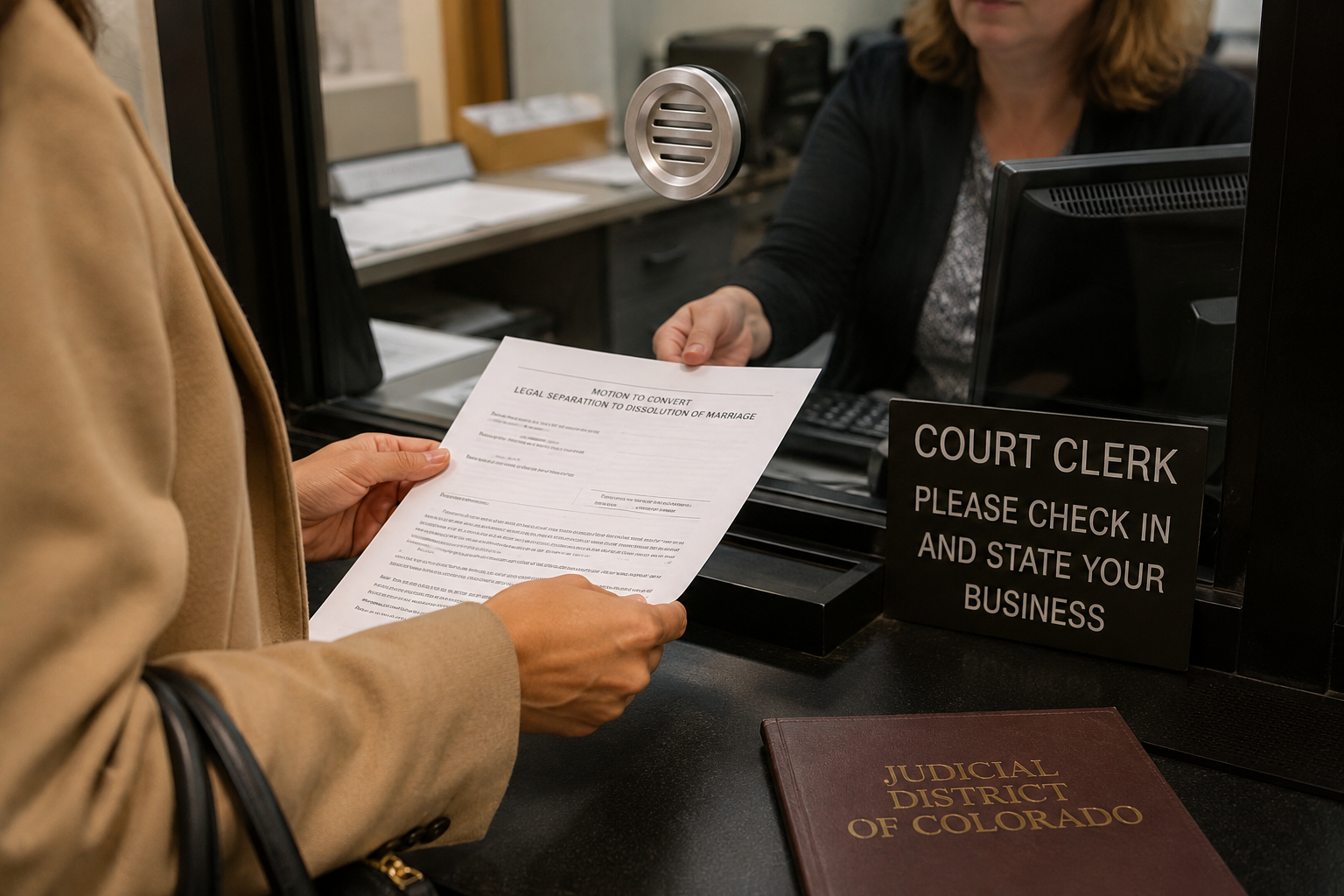
Either spouse can ask the court to convert a legal separation into a divorce, but not immediately. Colorado requires at least 182 days, to pass after the separation decree is entered before either party can file that motion.[2]
The motion also requires proof that the other spouse was notified by mail at their last-known address. Once those two conditions are met, the statute does not leave the court discretion, it must convert the decree into a dissolution of marriage. Because the underlying issues were typically already resolved in the separation, this process usually moves faster than filing a divorce from scratch.
Why Some Couples Choose Separation Over Divorce
- Preserving continued access to a spouse’s employer-based or military health insurance.
- Religious beliefs that discourage or prohibit divorce.
- Wanting time and structure to decide, without the finality of ending the marriage outright.
- Easing the transition for children by keeping the family status less abruptly final.
If insurance or benefits are the main reason you are considering separation instead of divorce, confirm the specific plan’s rules before you file anything. Some employer plans end dependent eligibility on legal separation, even though the marriage hasn’t ended, while military spouses generally keep TRICARE coverage while still legally married and only lose it when a divorce becomes final.
Why This Decision Is Worth a Second Opinion
Separation and divorce require nearly identical paperwork and produce nearly identical court orders, so the decision usually comes down to what you actually want your legal status to be afterward, not which process is simpler. Colorado divorce law treats both paths seriously, and getting the terms right the first time matters whether or not you ever convert the decree later.
Our attorneys walk through both options with you before you file either one, including what happens to your specific benefits, property, and parenting arrangement under each. Acting as your North Star means telling you plainly which path fits your actual goals, not steering you toward whichever case is faster for us to handle.
Frequently Asked Questions
Does legal separation automatically become a divorce in Colorado?
No. A separation decree stays in effect until one spouse files a motion to convert it, which can happen no earlier than 182 days after the decree is entered. Some couples remain legally separated for years without ever converting.
Can I remarry after a legal separation?
No, not while the separation decree remains in place. You are still legally married. You would need to convert the separation into a divorce and receive a final decree of dissolution before remarrying.
How long does a legal separation take in Colorado?
The same minimum as a divorce: at least 91 days after the court gains jurisdiction over both spouses, whether through joint filing or service on the responding spouse, though contested issues can extend that timeline well beyond the minimum.
Do I need a lawyer to file for legal separation?
It isn’t required, but the decree carries the same weight as a divorce judgment on support, property, and parenting. Getting those terms wrong can be just as costly as getting them wrong in a divorce.
Can one spouse convert a legal separation to divorce if the other objects?
Yes. Once the 182-day waiting period has passed and proper notice has been mailed, the court is required to convert the decree, regardless of whether the other spouse agrees.
Related Issue
- Separation and divorce both require resolving the same property, support, and parenting questions, and how you resolve them matters more than which label ends up on the decree. Our guide to divorce mediation in Colorado covers how couples negotiate those terms outside a courtroom, an option worth considering regardless of which decree you’re ultimately filing for.
Find Out Which Path Fits Your Marriage
Couples often assume legal separation is the easier, softer option, a way to avoid a hard decision. It isn’t. A separation decree can carry enforceable property, support, and parenting orders much like a divorce does, but staying legally married still changes things like taxes, inheritance, and remarriage, and the wrong choice here can be difficult to unwind later.
Talk to Johnson Law Group before you file either petition. Our family law attorneys will lay out what each path actually means for your benefits, your property, and your children, plainly, in a free consultation.
Reach one of our Colorado offices today. There’s no cost to ask the question first.
Sources:
Hear From Our Happy Clients
“Myles helped me resolve custody quickly and in a way that all parties were happy.”
Myles is very professional and well informed in his field. Cassidy their paralegal was also extremely helpful and client driven . 5 stars!
– Stevie
"Helped me through a difficult divorce and made what i thought was going to be an impossible process so much easier."
– Sonja
"Myles took great care in guiding a smooth process from start to finish drafting a prenuptial agreement."
He was responsive, efficient, and coordinated well with my wife’s attorney. Very happy with the final result.
– Nick
"My experience with the Johnson Law Group has been nothing more than spectacular."
From the initial phone call I spoke to Myles Johnson, he gave great direction on how to proceed. Then acquiring the firm as my legal representation I worked with Said and he helped me step by step to get what I was looking for. I have already recommended two different individuals I know to Johnson Law Group and will be using them for all future situations. From the legal team to Cory at the front desk, everyone at the firm is top-notch.
– Brady M.
"I'm extremely proud of the most professional and considerate Johnson Law Group."
l appreciate all the help my attorney and paralegal has done for me in the best interest of my daughters future. They’re all most knowledgeable, caring law group! I couldn’t have done it without their genuine support on representing my case(s). I’m grateful for all they have done for my daughter and I.
– Bonnita
Overboard: How to Avoid Sinking in Your Colorado Family Law Case
Written by Denver Family Law Attorney Myles S. Johnson
Divorce doesn’t have to be dramatic. For the litigants, losing your spouse is significant enough. But you can choose the way it affects your daily life. The only guarantee I can give is that the feeling that you have right now will not be the feeling you end with. This is a season in your life, and it must be approached that way.
This acclaimed book positions Johnson Law Group as a thought leader in Colorado family law, providing clients with the same proven strategies that have guided hundreds of families through successful outcomes.