
Explore Colorado Parenting Time Schedules
Compare common Colorado parenting time schedules, explore visual examples, and download a printable calendar to help plan your child’s routine.
Colorado has no statutory default parenting time schedule, so these examples illustrate possible arrangements for discussion. [1]
SEE THE PATTERN ACROSS A MONTH
Example Colorado parenting time calendar
This June 2026 calendar shows the 5-2-2-5 pattern continuing from week to week. Parent A has Monday and Tuesday overnights, Parent B has Wednesday and Thursday overnights, and the three-night weekends alternate.
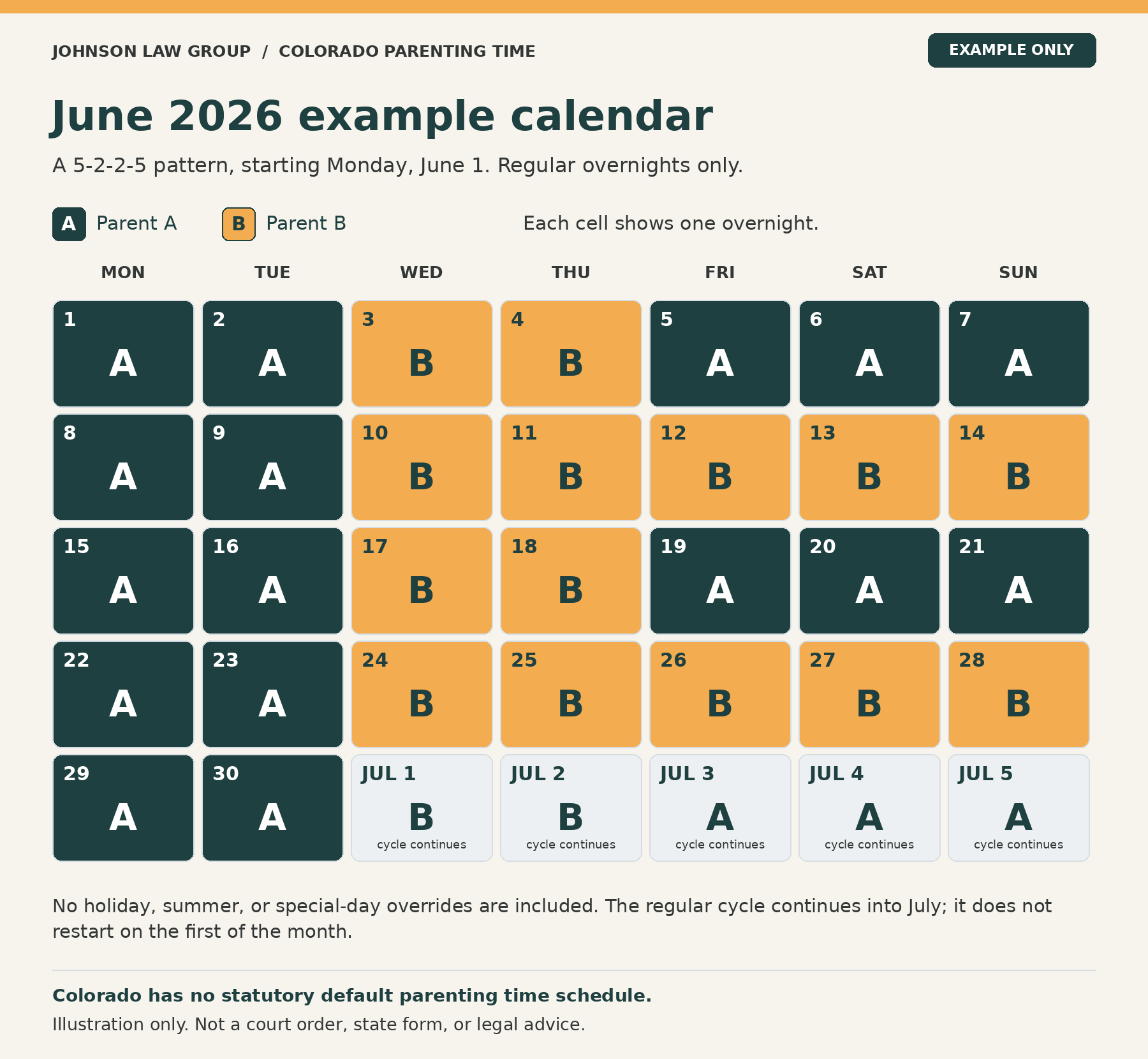
The Monday start makes the repeating pattern easy to see. The dates show a sample month, not an official Colorado court calendar; your own plan needs a start date, exchange times, and any holiday or vacation overrides.
Download the parenting time calendar pack
Print all four schedule examples, the full-month illustration, and a blank monthly worksheet. Bring the pages to a scheduling discussion or consultation and mark the details your family needs to resolve.
No email required. Educational examples only, not a court order, state form, or legal advice.
Get to know Johnson Law Group
ATTORNEY RECOGNITION




A CLIENT’S EXPERIENCE
“When you have someone in your corner that understands the importance of family it makes the situation a ton easier.”
Dwight
Read client reviews
FOUR WAYS A REGULAR SCHEDULE CAN LOOK
Compare common parenting time schedules
The useful comparison is how a pattern works for your child’s daily life. A schedule with equal overnights can still create difficult commutes, too many transitions, or stretches apart that do not fit a child’s needs.
Each example uses Parent A and Parent B without assigning either label to a mother or father. A colored day identifies where the child sleeps that night, not who has every hour of that day.
| Schedule | Parent A / B | What stays predictable | What to consider |
|---|---|---|---|
| Alternating weekends | 12 / 2 nights | School nights in one home | Longer gaps between Parent B’s overnight visits |
| 5-2-2-5 | 7 / 7 nights | The same two weekdays with each parent | Five consecutive nights apart from either parent |
| 2-2-3 | 7 / 7 nights | A repeating two-week pattern | More exchanges and weekdays that switch homes |
| Week-on/week-off | 7 / 7 nights | One exchange each week | Seven nights at a time away from either parent |
These counts describe only the pictured regular cycle. Holidays, vacations, added visits, and the calendar year can change actual totals.
Alternating weekends
In this example, Parent B has Friday and Saturday overnights every other weekend. The child returns to Parent A on Sunday evening, so Sunday’s overnight belongs to Parent A.
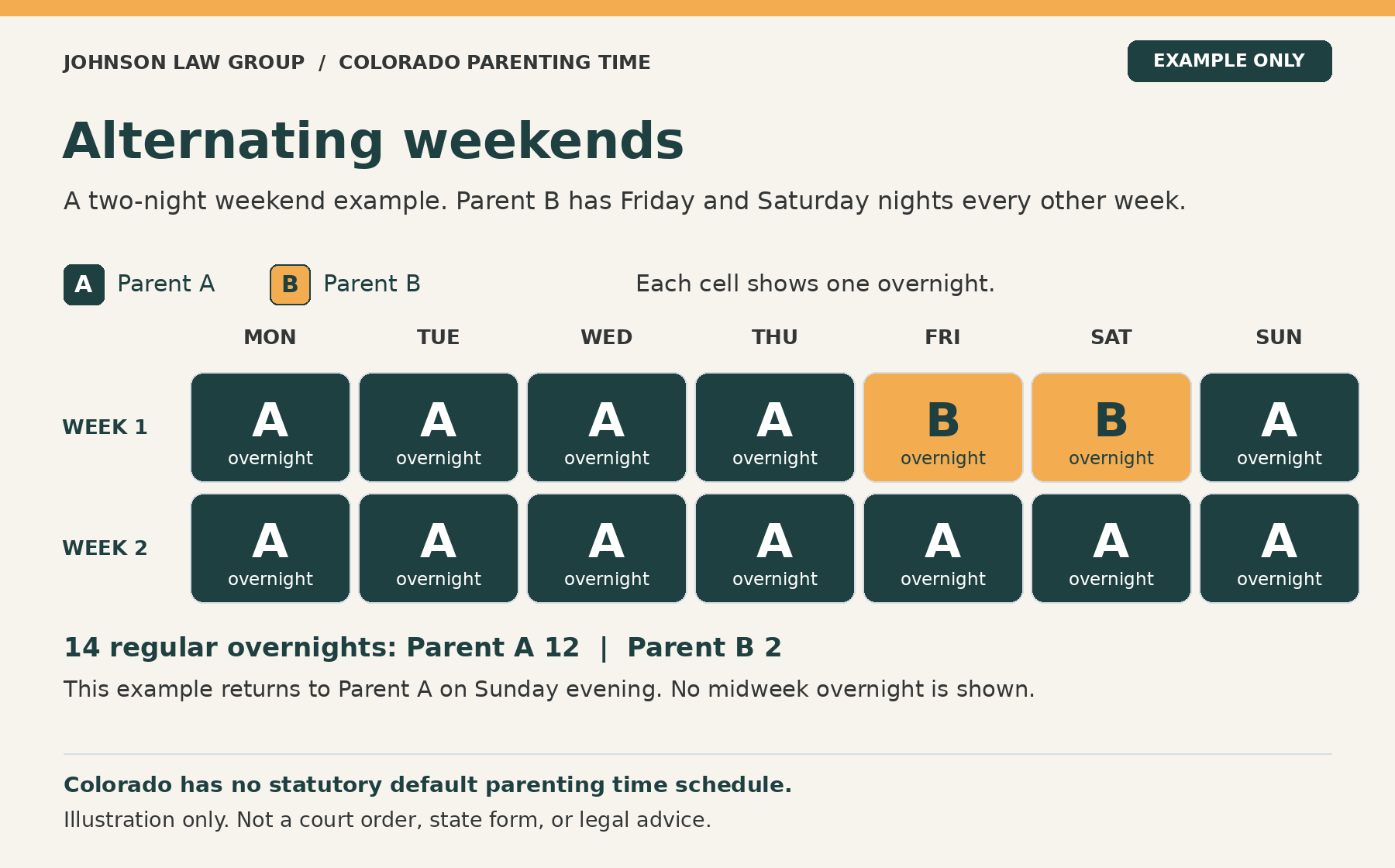
Practical tradeoff: Most school-night routines stay in one home, but Parent B has a long stretch without an overnight. A midweek dinner or other contact would need its own terms; it is not shown here.
“Every other weekend” is not the same as “first, third, and fifth weekends.” Specify the starting weekend and keep the alternating cycle running across month boundaries.
5-2-2-5
Parent A has Monday and Tuesday nights, and Parent B has Wednesday and Thursday nights every week. Friday through Sunday nights alternate between the parents.
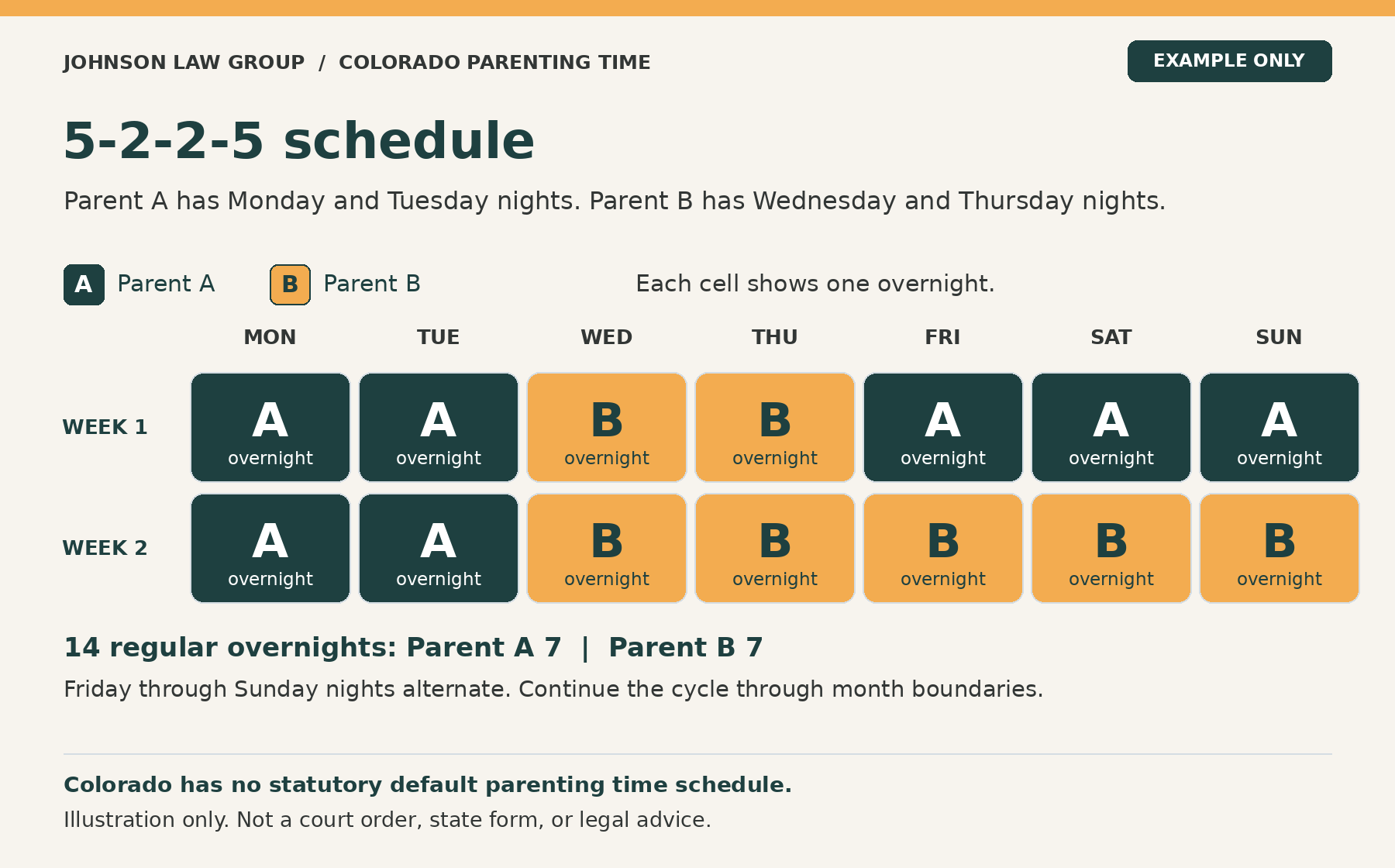
Practical tradeoff: Fixed weekdays can help parents coordinate recurring activities or work commitments. The five-night blocks still require the child to spend several nights away from the other home.
The five-night stretch crosses a week boundary for Parent A: Friday through Tuesday. Keep repeating the full cycle rather than restarting it each Monday or on the first day of a month.
A parenting time schedule should give your child a dependable routine and help your family move forward. Let our family help yours.
Contact us today to discuss your options and build a plan around your child’s needs.
2-2-3
The child spends two nights with Parent A, two with Parent B, and three with Parent A. The roles reverse the following week.
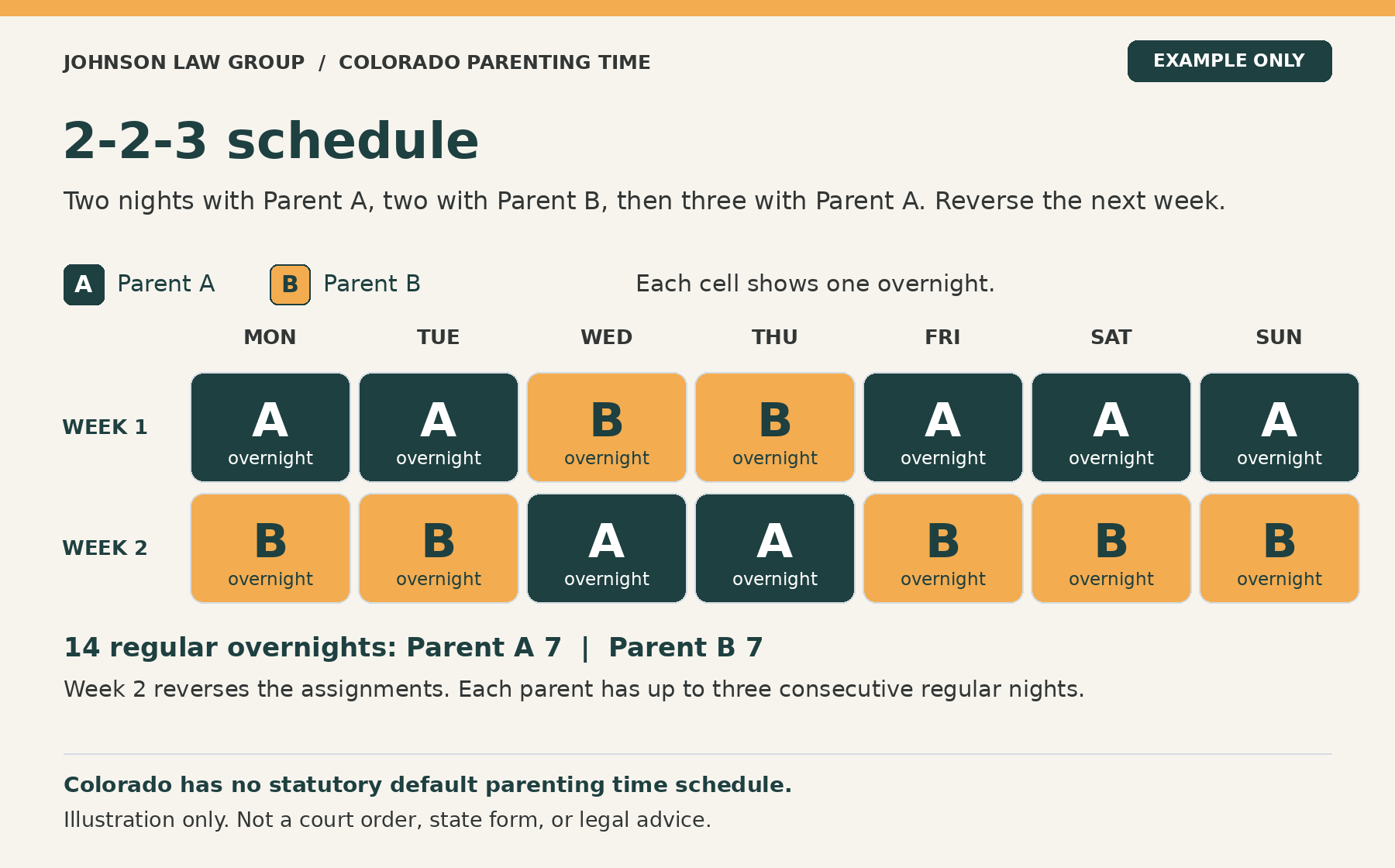
Practical tradeoff: The shorter stretches reduce time between stays in each home. They also mean more exchanges, and each parent’s school-night responsibilities change from one week to the next.
This pattern deserves a close look at travel time, school supplies, medication, and the child’s response to frequent transitions. Shorter blocks do not automatically make it the right choice for a younger child.
Week-on/week-off
The child spends seven consecutive nights with each parent, alternating homes each week. This example starts Parent A’s week on Monday and Parent B’s week the next Monday.
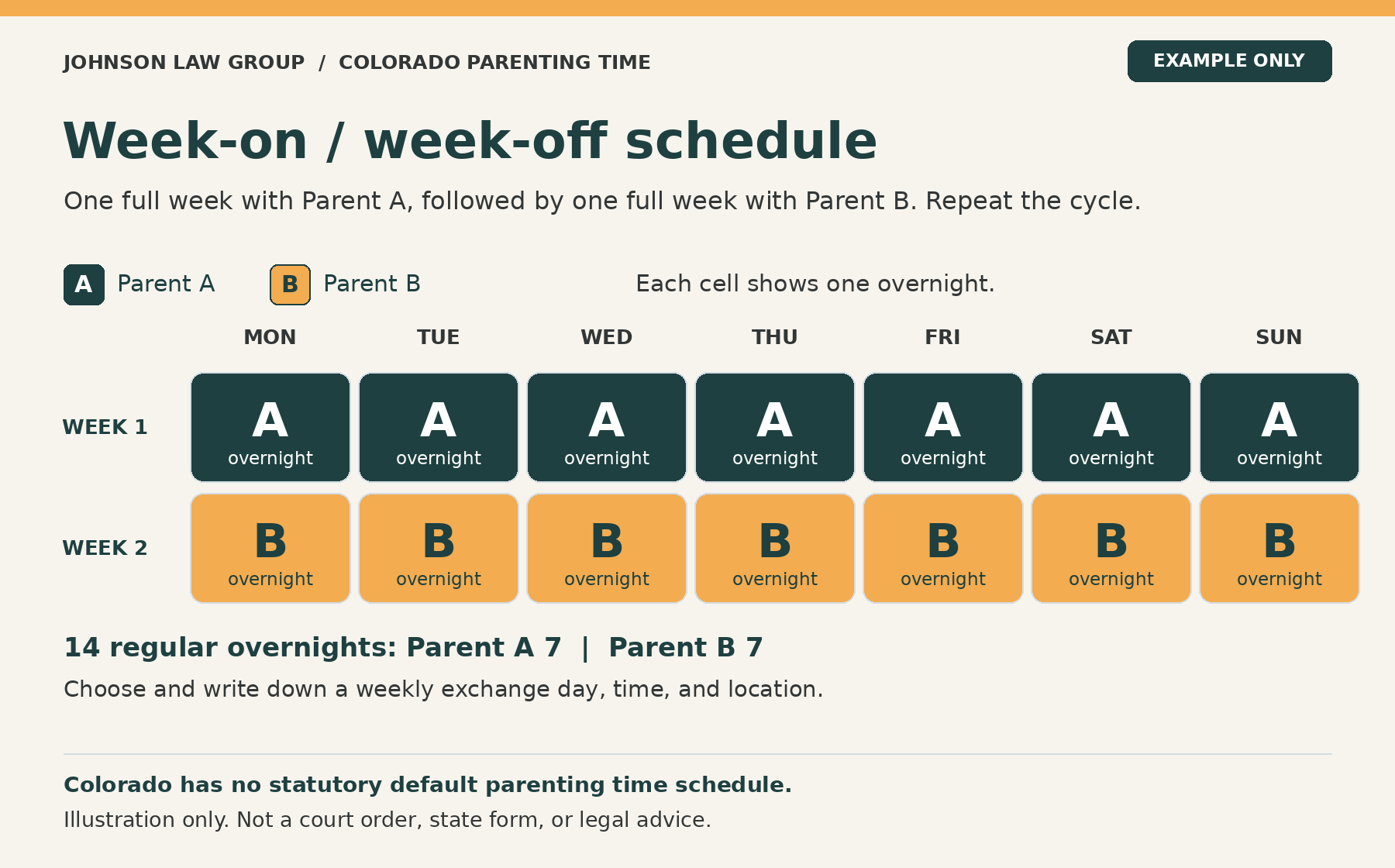
Practical tradeoff: Fewer exchanges can simplify transportation and give each home a full week of routine. A child also spends a full week away from the other parent.
If appropriate, planned calls or a midweek visit can help maintain contact. Agree on those details separately rather than assuming that “alternating weeks” includes them.
Choose around your child’s needs and daily routine
Colorado’s best interests analysis considers the child’s circumstances, including safety and practical needs. Relevant considerations include relationships, adjustment to home and school, each parent’s past involvement, and the distance between homes. The full standard is broader than this short list.
When comparing calendars, write down what each option would mean for:
- School and childcare: Test the actual morning and afternoon travel time from both homes, including traffic and winter conditions.
- Age and development: Consider sleep, feeding, emotional needs, and how the child handles time away from each parent.
- Existing routines: Account for activities, healthcare, sibling relationships, and the care each parent already provides.
- Work and exchanges: Identify who can handle pickups and what happens when school is closed or a shift changes.
- Safety: Consider whether ordinary exchanges or unsupervised time would create a risk.
If domestic violence, child abuse, or another safety concern is involved, do not choose a routine rotation without addressing that concern. Colorado law provides specific safety requirements, and a schedule may need protections beyond what these illustrations show.
Parenting time is part of the broader allocation of parental responsibilities in Colorado. A calendar alone does not determine who makes major decisions for a child.
Add the details that make a calendar usable
A rotation needs precise exchange and exception terms to work in real life. Colorado’s JDF 1113 Parenting Plan form separates the school-year schedule, summer, holidays, overnights, transportation, and telephone access. [2]
Your weekly schedule is one part of a complete Colorado parenting plan, which also addresses decision-making and other responsibilities. This guide focuses on what the parenting time portion looks like on a calendar.
- Set the starting point. Name the first date, the parent beginning the rotation, and how the cycle continues into the next month.
- Define exchanges. State the day, time, location, transportation responsibility, and a clear alternative when school is closed.
- Assign holidays and school breaks. Include exact start and end times, odd/even-year assignments where used, and overlapping occasions.
- Set summer and vacation terms. Address notice, conflicting vacation requests, and whether the regular rotation continues.
- Explain the return to the regular schedule. Say where the child goes when a holiday ends and whether the underlying rotation continues.
Holiday example: The regular schedule puts a child with Parent A on Friday night, but an assigned holiday gives that period to Parent B. Under JDF 1113’s holiday section, the specified holiday schedule takes priority over the regular school-year and summer schedules; a holiday left blank follows the regular schedule.
Exchange wording example: “The parent beginning parenting time picks up the child at school dismissal. If school is closed, the exchange is at 4:00 p.m. at the agreed location.” This illustrates the level of detail to discuss, not complete language for an order.
Your controlling order matters. A privately marked calendar does not, by itself, modify that order; the court addresses parenting time modifications under C.R.S. 14-10-129. [3]
Questions parents ask about Colorado schedules
Is there a standard possession order in Colorado?
No. There is no Colorado SPO equivalent that supplies a default calendar. If you are searching for “standard possession order Colorado” or a “standard parenting time schedule Colorado,” the practical starting point is an individualized schedule, not a statewide rotation.
You may recognize the SPO term from Texas. In Colorado, choosing a familiar pattern does not make it the legally preferred schedule, and equal parenting time is not automatic.
Does Colorado require a 50/50 parenting time schedule?
No. A 50/50 schedule is an option, not an automatic entitlement or statewide requirement. The court applies the best interests standard to the child’s circumstances.
Is 5-2-2-5 the same as 2-2-3?
No. Both illustrated patterns split 14 regular overnights equally, but 5-2-2-5 keeps each parent’s weekdays fixed. In 2-2-3, the parents’ weekdays switch the following week and the child changes homes more often.
Which parenting time schedule is best for a toddler?
No single pattern is best for every toddler. Existing caregiving, attachment, sleep, feeding, safety, and how the child handles transitions should shape the discussion. An age label alone is not enough to choose a schedule.
What if the parents live far apart?
Start by testing whether school-day travel is practical. A pattern with frequent weekday exchanges can be difficult when homes are far apart; longer blocks during breaks may be worth discussing. Distance does not create an automatic schedule or change an existing order.
Does moving from Texas to Colorado replace my Texas order?
No. Moving does not automatically replace an existing Texas custody order with a Colorado schedule. Colorado’s authority to modify another state’s order is governed by the UCCJEA, including C.R.S. 14-13-203. [4]
Have the existing order and jurisdiction reviewed before treating a different calendar as a replacement.
Can we submit this downloadable calendar as our parenting plan?
The download is a discussion aid, not a completed parenting plan or court form. It does not establish exchange terms, decision-making responsibilities, or other provisions your case may require.
Turn a sample schedule into a plan for your family
Johnson Law Group can help you evaluate a proposed parenting time schedule and the details needed to put it into practice. Our team takes time to understand your concerns and explain your options so you can make informed decisions.
Bring your current order, your child’s school calendar, both parents’ work schedules, and the example you are considering. We can discuss where it fits, where it creates problems, and what needs to be addressed.
Sources
General educational information. These examples do not predict a court’s decision or replace advice about your case.